
Moving and Packing Supplies: What You Actually Need (and Where to Get It Cheap)
Most people underestimate their moving and packing supplies twice – once when they guess how many boxes they’ll need, and again when a box gives out halfway to the truck. After enough moves, a pattern becomes obvious: the supplies matter almost as much as the movers. Cheap tape splits at the seam. Undersized boxes get overpacked and split at the bottom. A missing roll of bubble wrap turns into a scramble for old towels at 9 p.m.
This guide breaks down exactly what moving and packing supplies you need, where to find them cheap (including free), what to know about Home Depot moving boxes specifically, and how much to actually buy based on your home size – all from the perspective of a crew that packs and loads homes for a living.
What Counts as Moving and Packing Supplies?
- Boxes: Small, medium, large, extra-large, and specialty boxes (wardrobe, dish pack, picture/mirror, book box).
- Cushioning and protection: Packing paper, bubble wrap, foam sheets, furniture blankets, and corner protectors.
- Fasteners and tools: Packing tape (with a dispenser), box cutters, permanent markers, and labels.
- Moving equipment: Furniture dollies, moving straps, and stretch wrap for upholstery.
Standard Box Sizes and What Goes in Them

Cheap Moving Supplies: Where to Find Them Without Overpaying
Free Sources (Best If You Have 2+ Weeks)
- Grocery and liquor stores: Produce boxes offer sturdy build quality. Liquor boxes feature built-in dividers that work wonders for glassware.
- Office supply stores and workplaces: Copy paper boxes feature a near-perfect size and stack cleanly.
- Online marketplaces and community groups: Local “free stuff” listings frequently feature people offloading clean boxes right after a move.
- Retailer pickup schedules: Some stores flatten and bundle boxes for recycling pickup at set times. Asking an employee for that schedule can net you a free stack.
Budget Retail (Best If You Need Consistency)
Moving Company Box Programs
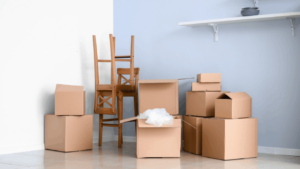
Home Depot Moving Boxes: What to Know Before You Buy
- Kits target home sizes: Home Depot sells bundled kits labeled for studios, one-bedroom units, two-bedroom homes, and larger spaces. This simplifies quantity planning.
- Specialty lines matter for fragile items: Their dish pack and picture/mirror boxes use double-wall construction. They hold up much better under heavy loads than standard single-wall boxes.
- Cardboard remains recyclable: Breaking down and recycling boxes afterward is straightforward through standard curbside programs.
- In-store pickup saves money: Picking up orders avoids shipping fees and lets you inspect box quality before committing to bulk purchases.
Packing Materials That Protect Your Stuff
What Works Well
-
Packing paper: Unprinted newsprint wraps dishes and glassware cleanly without transferring ink onto light-colored items.
-
Bubble wrap: Reserve this for fragile or high-value items (like electronics, glass, and ceramics) to keep costs manageable.
-
Furniture blankets: These protect large furniture and appliances from scuffs during transit.
-
Towels, linens, and clothing: These provide great cushioning for medium-fragility items. You must move them anyway, so they perform double duty.
What to Avoid
-
Regular newspaper: Ink smudges onto light-colored dishes and proves difficult to clean.
-
Plastic garbage bags for clothing: Bags tear easily under weight and fail to stack, wasting valuable truck space.
-
Loose-fill packing peanuts: These shift during transport and allow breakables to collide inside boxes.
-
Overtaping flimsy boxes: Tape reinforces seams, but it cannot fix an incorrectly sized or water-damaged box.
How Many Boxes and Supplies Do You Need?
-
Studio or 1-Bedroom: 10–12 small boxes, 15–20 medium boxes, 5–8 large boxes.
-
2-Bedroom Home: 15–20 small boxes, 25–30 medium boxes, 10–15 large boxes.
-
3-Bedroom Home: 20–25 small boxes, 35–40 medium boxes, 15–20 large boxes.
Packing Supplies Checklist by Room
-
Kitchen: Dish pack boxes, packing paper, small boxes for canned goods, medium boxes for pots, and reinforced tape.
-
Bedroom: Wardrobe boxes, medium boxes for folded clothing, large boxes for bedding.
-
Living Room: Furniture blankets, upholstery stretch wrap, picture/mirror boxes, bubble wrap.
-
Bathroom: Small-to-medium boxes, resealable bags for leak-prone liquids, packing paper for glass items.
-
Garage/Storage: Heavy-duty boxes for tools, furniture dollies for motorized items, extra reinforced tape.
Common Packing Mistakes That Cost You Money
-
Mixing weights in one box: Placing a heavy lamp on top of a stack of books usually results in a broken lamp.
-
Skipping bottom reinforcement: A single strip of tape fails on boxes weighing over 20 pounds. Use the H-taping method (one strip down the center seam, plus one across each end).
-
Under-labeling boxes: Labeling every box simply as “kitchen” forces you to open all of them during unpacking. Add a contents note (e.g., “Kitchen – Glasses”) to save time.
-
Leaving air gaps: Under-filled boxes collapse under stacking weight. Fill gaps with paper or towels.
———————————————


